|
Technicalities of Double Jeopardy
Double jeopardy, legally know as Autrefois Acquit (previously acquitted) or Autrefois Convict, is the ancient common law legal principle that no person can be tried for the same alleged crime twice.
Even though it does allow repeat prosecutions for two distinct actions that occurred in the same situation, for example robbery and murder, it did not allow (at least in Commonwealth Common Law countries) in essence the same conduct, such as causing the death of a person, to be prosecuted consecutively as dissimilar crimes such as murder, manslaughter or denial of civil rights.
It prevented a repeat prosecution after someone had been found not guilty, or even after someone had been found guilty if the subsequent prosecution were to be for a more serious charge than the original. Ie A person found guilty of petty theft could not then be charged with grand larceny if it relates to the same object stolen.
Also, for an accused to call upon this law, he had to be at least first convicted/acquitted by a jury or acquitted by a court (appellate or original jurisdiction) rather than just a court case coming to an end. An accused is considered to have been acquitted if the jury declares a ‘not guilty’ verdict; if during the trial, the judge should declare the accused has ‘no case to answer’ and direct the jury to bring in a verdict of not guilty; or if after a guilty verdict has been brought in, an appellate court should overrule the verdict and acquit the accused. Double jeopardy was and is not available merely where a jury cannot arrive at a verdict or where adverse circumstances, such as the death of the judge, might warrant the cessation of the trial.
The law is absolute and there were no exceptions to the above. If it was reasonable to believe that the accused in a criminal trial was acquitted because he committed perjury; suborned perjury; threatened a witness; bribed members of the jury; arranged to have family members of the judge held hostage for the duration of the court proceedings#, then this would still have no effect upon the legitimacy of his acquittal.
Once acquitted, a person could never be retried despite:
-
Evidence
-
Error of Law
-
Corruption of Process
“...double jeopardy unequivocally prohibits a second trial following an acquittal, [as the] public interest in the finality of criminal judgements is so strong that an acquitted defendant may not be tried even though the acquittal was based on an egregiously erroneous foundation...”∞
Current Australian Law as of 2012
In July 2006 the Council of Australian Governments (COAG) agreed that reform of the rule against double jeopardy was an important criminal law policy reform that merited nationally consistent treatment. Through recommendations made by the so called Model Criminal Code Officers Committee (MCCOC) they created a model for reform, knows as the Model Agreed by COAG, to be a template for reform for all Australian states. As of May 2012 all Australian states have now instituted reforms which have been, even though not exactly similar, closely following the recommended model.
Judging by the total lack of prosecutions, let alone convictions, since 2006, it is a point of debate as to whether these changes to the law regarding criminal appeals are meaningful or nothing more than cosmetic reforms on paper, while in substance allowing a possible token re-prosecution of a suspected felon nothing more than once every decade.
With minor exceptions, the new laws of all the states allow a repeat prosecution where a false acquittal is believed to have occurred, unless:
-
The false acquittal is due to the judge mistakenly denying valid evidence.
-
The false acquittal is due to the judge giving incorrect directions to the jury.
-
The false acquittal is due to jury tampering (bribery or threatening harm) and although evidence of such is compelling, there has been no conviction for said crimes (due to possible death or disappearance of accomplice).
-
The false acquittal is due to witness tampering (bribery or threatening harm) and although evidence of such is compelling, there has been no conviction for said crimes.
-
The evidence to be presented by the DPP is not new even though it has never been presented to a jury.
-
There is fresh and compelling evidence of guilt of the original crime but a repeat trial has already been allowed.
-
There is fresh and compelling evidence of guilt of the original crime but the police or prosecution have not acted with due diligence in applying.
-
There is fresh and compelling evidence of guilt of the original crime but there has been a substantial (not defined) length of time since the original alleged offence.
-
Someone has been convicted of an administration of justice offence (perjury, intimidation, etc) which is believed to have led to a tainted acquittal at the original trial, but a repeat trial on fresh and compelling evidence has already been allowed.
-
The crime the suspect is charged with is not more serious than rape, aggravated burglary or armed robbery where torture, serious injury to the victim or serious threats of harm did not occur.
-
Where the original acquittal was tainted due to an administration of justice offence, the penalty of the original crime is less than 15 years incarceration.
-
The court declares that “in all the circumstances it is [not] in the interests of justice”.
-
The original crime occurred before the date of enactment of the new law (Queensland).
Ω ABC News 7th August 2007
§ Queensland Press Forum Luncheon, 9th April 2003
¥ cited in ‘Justice at last: killer pleads guilty in Britain's first double jeopardy trial’, The Guardian, 12th Sep 2006
‡ ‘21 reasons you won't get justice from the adversarial court system’ 7th April 2003, http://www.onlineopinion.com.au/view.asp?article=268
# Normally double jeopardy would not prevent prosecutions for the aforementioned separate and distinct crimes committed by the accused in his attempt to evade a possible more serious conviction, but with the High Court decision of R v Carroll this is in doubt with the crime of perjury.
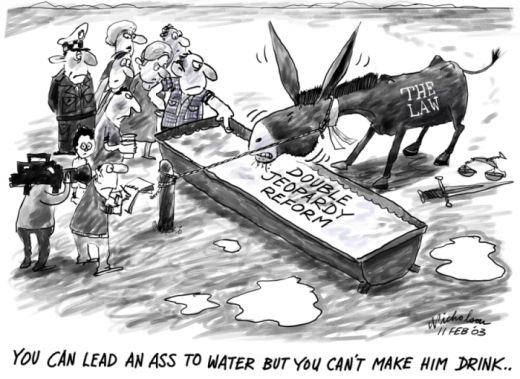
* The inclusion of the above cartoon is not to be interpreted that either Peter Nicholson (www.nicholsoncartoons.com.au) or the newspaper The Australian necessarily endorse all the criticisms or suggestions for reform of the law known as double jeopardy as mentioned on this site.
∞ Rodrigues v. Hawaii, 469 U.S. 1078, at 1079 (1984)
|